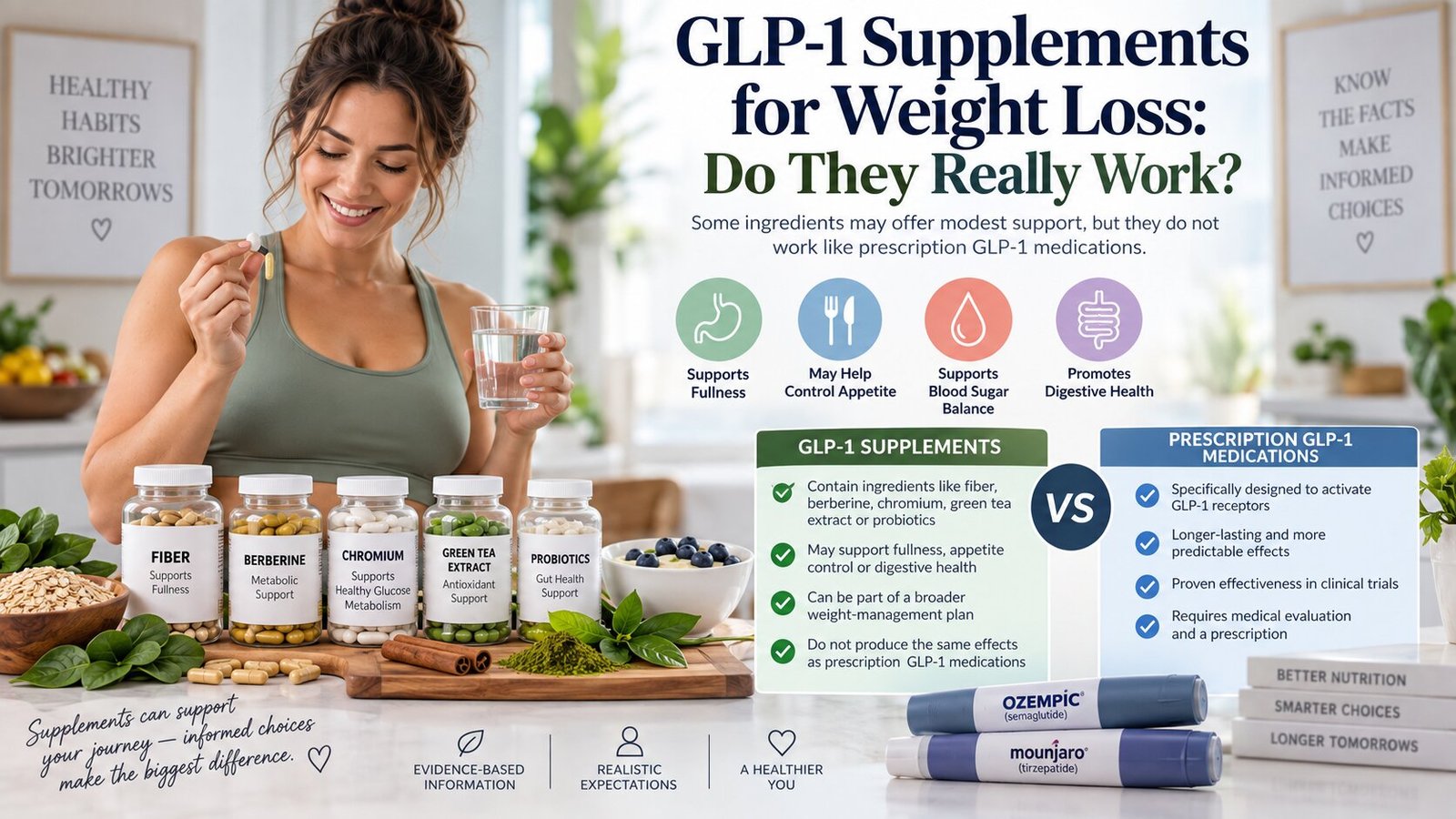
If you have spent any time looking at weight-loss products lately, you have probably noticed a new phrase appearing everywhere: GLP-1 supplements. You may see capsules, powders, gummies, and drink mixes promising to “boost GLP-1,” control cravings, increase fullness, or deliver a natural version of the results associated with popular prescription medications. It is an appealing idea, especially if you would rather avoid injections, prescription medications, or the cost and monitoring that can come with medical weight management. But once you move past the marketing language and ask what these products actually do in the human body, the picture becomes considerably less exciting.
The important distinction is that natural GLP-1 support is not the same thing as taking a GLP-1 receptor agonist. Your body naturally produces GLP-1 after you eat, and several nutrients can influence the hormones and digestive signals involved in appetite and metabolism. That does not mean a capsule containing fiber, berberine, chromium, green tea extract, or probiotics can reproduce the pharmacological effects of a medication such as semaglutide. Some ingredients may have useful roles in a broader weight-management strategy, but the evidence generally does not support treating over-the-counter supplements as equivalent substitutes for prescription therapy.
So, do GLP-1 supplements for weight loss really work? The most honest answer is some ingredients may provide modest support, but there is no convincing evidence that an ordinary over-the-counter “GLP-1 booster” produces weight loss comparable to an approved GLP-1 medication. That difference matters because the label on a supplement can sound much more definitive than the science behind it. Before spending money on one, it helps to understand what GLP-1 actually is, what these supplements contain, what research has—and has not—shown, and where medical treatment may fit into the bigger picture.
What Is GLP-1?
GLP-1, or glucagon-like peptide-1, is a hormone your body naturally produces, particularly in response to eating. It is part of a sophisticated network connecting the digestive system, pancreas, brain, and other tissues involved in energy regulation. After a meal, GLP-1 contributes to signals that tell your brain you have eaten, supports insulin secretion when glucose is elevated, suppresses glucagon secretion, and slows gastric emptying. These actions can influence how quickly food moves through your digestive system and how satisfied you feel after eating.
That natural process is one reason GLP-1 has become such an important topic in modern weight management. Appetite is not simply a matter of discipline or motivation. Your body is constantly receiving hormonal and neurological signals about hunger, satiety, available energy, and food intake. GLP-1 is one piece of that system. The hormone can help reinforce the feeling that a meal is enough, which may affect how much someone eats over the course of a day.
The catch is that naturally produced GLP-1 is broken down relatively quickly by the enzyme DPP-4. Prescription medications designed around the GLP-1 pathway are engineered to have much longer-lasting effects. That distinction is crucial when evaluating supplements marketed as “natural GLP-1 boosters.” A food or supplement may influence GLP-1 secretion under certain circumstances, but that is fundamentally different from a medication specifically designed to activate GLP-1 receptors for an extended period.
How GLP-1 Affects Appetite and Blood Sugar
Think of GLP-1 as one of the body\'s meal-response messengers. When you eat, your digestive system does not simply process calories mechanically; it communicates with the brain and metabolic organs. GLP-1 participates in that communication by helping signal satiety and by influencing glucose regulation. It can slow gastric emptying, which means food may leave the stomach more gradually, and it can contribute to the feeling that you have had enough to eat.
GLP-1 also has an important relationship with the pancreas. When blood glucose rises after a meal, GLP-1 can enhance glucose-dependent insulin secretion. At the same time, it can reduce glucagon secretion. Since glucagon generally promotes an increase in blood glucose, reducing inappropriate glucagon activity is another way GLP-1 participates in glucose control.
This does not mean that increasing GLP-1 by any possible method automatically causes substantial fat loss. Human metabolism is far too complicated for a single hormone to explain everything. Appetite, sleep, muscle mass, physical activity, food composition, insulin sensitivity, genetics, medications, stress, age, and numerous other factors can influence body weight. That is why it is risky to look at one ingredient that appears to influence GLP-1 in a laboratory or small clinical study and immediately conclude that the finished supplement will cause meaningful weight loss.
Natural GLP-1 vs. Prescription GLP-1 Medications
This is where many advertisements blur an important line. Your body\'s natural GLP-1 and a prescription GLP-1 medication are not interchangeable. Natural GLP-1 is released in response to meals and has a short duration of action (minutes). Prescription GLP-1 receptor agonists are medications developed specifically to resist rapid degradation and activate the GLP-1 receptor in a controlled and sustained manner over days or weeks.
That pharmaceutical design is one reason prescription medications can have much stronger and more predictable effects than simply eating a particular food or taking a supplement. Approved medications undergo controlled clinical trials, have standardized active ingredients and doses, and are accompanied by prescribing information describing their appropriate uses, contraindications, warnings, and adverse effects.
Some newer medications also target additional metabolic pathways. Tirzepatide (Zepbound / Mounjaro), for example, acts on both GIP and GLP-1 receptors. That is another reminder that modern obesity treatment is not simply about finding a food or supplement that temporarily raises one hormone.
A supplement company can reasonably discuss research into appetite hormones. What it cannot honestly do is turn that research into proof that its particular capsule works like a prescription drug when such evidence does not exist.
What Are GLP-1 Supplements?
There is no single medically standardized category known as a “GLP-1 supplement.” Instead, the phrase is primarily a marketing term used for products that claim to support pathways associated with appetite, blood sugar, digestion, or GLP-1 signaling. The actual formulas can differ dramatically from one brand to another.
One bottle might contain psyllium and other soluble fibers. Another may combine berberine, cinnamon, chromium, green tea extract, and botanical ingredients. A third might focus on probiotics and prebiotics. Some products are sold as gummies or flavored powders rather than traditional capsules, which can make them feel more like everyday wellness products than weight-management interventions.
The ingredients themselves are not necessarily useless. Fiber, protein, and certain other nutrients can absolutely play valuable roles in a healthy diet and weight-management strategy. The problem comes when a modest nutritional effect gets wrapped in pharmaceutical-sounding language.
For example, if a fiber supplement helps someone feel fuller and therefore makes it easier to maintain an appropriate calorie intake, that can be useful. But that is not evidence that the product is equivalent to semaglutide. Similarly, if an ingredient affects a laboratory marker related to glucose metabolism, that does not automatically translate into clinically meaningful fat loss.
Why the Term “GLP-1 Booster” Can Be Misleading
Imagine a product containing an ingredient that increases GLP-1 secretion slightly under certain experimental conditions. It may be tempting to describe that product as a “natural GLP-1 booster.” The phrase is technically suggestive, but it can create an impression that the product works like a prescription medication. Those are very different claims.
Mechanism vs. Clinical Outcome
The critical question is not simply, “Does this ingredient affect GLP-1 in a test tube or rodent study?” Instead, ask: Does this exact finished product, at this exact dose, produce meaningful and sustained weight loss in well-designed human clinical trials? That question changes the conversation completely. A biological mechanism is not the same as a real-world clinical outcome.
A supplement can contain an ingredient with interesting biological activity while still failing to produce a significant real-world weight-loss benefit. Research may involve a small number of participants, a short follow-up period, a specialized population, or a dose that differs from what consumers actually receive. Even positive findings for one ingredient cannot automatically be transferred to an entire multi-ingredient formula.
Do GLP-1 Supplements Really Work for Weight Loss?
For people searching specifically for GLP-1 supplements for weight loss, this is the question that matters most. The evidence does not support the idea that commercially available over-the-counter supplements reliably reproduce the degree of weight loss achieved with approved GLP-1-based medications.
That does not mean every ingredient has zero value. Some may have modest effects on satiety, glucose regulation, digestion, or dietary adherence. But those effects should be placed in context. A small improvement in fullness from adding soluble fiber to an otherwise balanced diet is useful, yet it is not comparable to the appetite reduction that can occur with pharmacological GLP-1 receptor activation.
The NIH\'s Office of Dietary Supplements has noted that there is limited evidence supporting many products marketed for weight loss, while some can produce side effects or interact with medications. This is particularly important because consumers may assume that an over-the-counter product has already been proven effective simply because it is legally sold. Availability is not the same as proof.
What the Research Actually Tells Us
The broader research landscape suggests that dietary supplements generally have much weaker evidence for substantial, durable weight loss than approved obesity medications. Some individual ingredients have been investigated, but results vary considerably.
There is another issue that deserves attention: weight loss is not simply about moving the number on the scale downward. A useful treatment should ideally support improvements in metabolic health while helping preserve lean mass and making long-term weight management more sustainable. A product that causes a tiny temporary change in body weight may not provide meaningful clinical value.
This is why comparisons with medications such as semaglutide or tirzepatide need to be handled carefully. Prescription medications have been evaluated in large clinical development programs specifically designed to determine efficacy and safety. A supplement with a handful of ingredients does not automatically inherit that evidence because one component happens to affect an appetite-related pathway.
If a product promises to “work exactly like Ozempic,” “mimic GLP-1 injections,” or deliver prescription-level weight loss naturally, treat that language as a reason to investigate—not as proof that the claim is true.
GLP-1 Supplements vs. Prescription GLP-1 Medications
One of the easiest mistakes to make when researching weight loss is treating all products associated with GLP-1 as though they belong to the same category. They do not. A dietary supplement marketed as a GLP-1 booster and an FDA-approved prescription medication that targets the GLP-1 receptor are fundamentally different products, with different standards of evidence, manufacturing requirements, dosing, and clinical oversight.
Prescription medications such as semaglutide (Wegovy® for chronic weight management, Ozempic® for type 2 diabetes) and tirzepatide (Zepbound® for chronic weight management, Mounjaro® for type 2 diabetes) have been rigorously evaluated in controlled clinical trials. For chronic weight management, these medications are FDA-indicated as an adjunct to a reduced-calorie diet and increased physical activity for adults with an initial Body Mass Index (BMI) of 30 kg/m² or greater (obesity), or 27 kg/m² or greater (overweight) in the presence of at least one weight-related comorbidity (such as hypertension, dyslipidemia, type 2 diabetes, or obstructive sleep apnea). Wegovy also holds an expanded FDA indication to reduce the risk of major adverse cardiovascular events in adults with established cardiovascular disease and overweight or obesity.
Their active ingredients, dosages, routes of administration, benefits, contraindications (such as personal or family history of medullary thyroid carcinoma or Multiple Endocrine Neoplasia syndrome type 2), and potential adverse effects are established through multi-center research and regulatory review. They require individual evaluation and prescription by a licensed healthcare provider (such as a physician or qualified clinician working within state scope of practice) and ongoing clinical supervision.
Key Differences in Evidence, Dosing, and Safety
| Factor | GLP-1 Supplements | Prescription GLP-1 Medications |
|---|---|---|
| Main Purpose & Indications | Marketed for appetite or general metabolic support (not FDA-approved to treat diseases) | FDA-approved for chronic weight management (BMI ≥30 or ≥27 with comorbidity) & type 2 diabetes; CV risk reduction (Wegovy) |
| Active Ingredients | Proprietary blends of herbs, fibers, minerals, or botanicals | Specific, standardized active peptide (e.g. Semaglutide, Tirzepatide) |
| Evidence for Weight Loss | Often limited, mixed, or single-ingredient laboratory studies | Rigorous, multi-phase double-blind clinical trials (STEP 1 / SURMOUNT-1) |
| Dosing | Varies widely by product and manufacturer | Standardized clinical titration schedules |
| Medical Evaluation & Prescribing | Usually not required to purchase over the counter | Mandatory clinical evaluation and prescription by a licensed healthcare provider |
| Safety & Side Effects | Variable; unstandardized quality control | Established warnings, precautions, and side-effect profiles |
| Clinical Monitoring | Often absent | Ongoing monitoring of metabolic markers, body composition & tolerance |
The table does not mean supplements are inherently bad or prescription medications are automatically better for every person. It simply highlights why they should not be presented as equivalent. The appropriate treatment depends on the individual, not on which product has the most convincing label.
Common Ingredients Found in GLP-1 Supplements
Once you look past the “GLP-1” branding, many supplements marketed for weight loss contain familiar nutritional or botanical ingredients. Some have reasonable evidence for specific health effects, while others have much less convincing data. Understanding what each ingredient can realistically do is more useful than judging a supplement by its marketing name.
Soluble Fiber, Berberine, and Green Tea Extract
Soluble fiber is probably one of the more practical ingredients found in products marketed around appetite control. Psyllium and other soluble fibers absorb water and form a gel-like material in the digestive tract. That can contribute to fullness and may help support regular bowel movements and healthier post-meal glucose responses. Fiber-rich foods such as beans, vegetables, fruit, oats, and certain whole grains are therefore valuable parts of a weight-management diet.
But fiber has limits. It does not transform into a GLP-1 medication simply because it can influence digestive hormones. Increasing fiber rapidly can also cause bloating, gas, constipation, or diarrhea, particularly if fluid intake is inadequate. Fiber supplements can also interfere with the absorption of certain medications when taken too closely together.
Berberine is another ingredient that receives substantial attention online, often dubbed “nature\'s Ozempic.” It is a naturally occurring plant alkaloid studied for effects on glucose metabolism and lipid profiles. While some research suggests potential benefits for glycemic markers, calling berberine “nature\'s Ozempic” is a major oversimplification. It is not a GLP-1 receptor agonist, cannot produce the sustained pharmacological appetite suppression of semaglutide, and can cause gastrointestinal distress or interact with prescription medications.
Green tea extract is frequently included in fat-burning formulas because green tea contains catechins (EGCG) and caffeine. Drinking brewed green tea as part of a balanced diet is healthy, but consuming concentrated extracts in supplement form carries limited evidence for meaningful weight loss and has been associated with rare cases of liver toxicity when taken in excessive doses.
Probiotics, Chromium, and Protein
Probiotics and prebiotics: The gut microbiome is a major frontier in metabolic research. While gut microbes do interact with digestion and metabolic signaling, probiotic science is highly strain-specific. A generic over-the-counter probiotic cannot be assumed to increase GLP-1 sufficiently to drive meaningful fat loss.
Chromium: Commonly marketed for blood-sugar management and craving control, clinical trials have generally failed to demonstrate a clinically significant impact on body weight.
Protein: While protein is a macronutrient rather than a pharmaceutical supplement, it is perhaps the most potent nutritional tool for satiety and metabolic support. Protein stimulates satiety hormones (including endogenous GLP-1 and PYY), supports muscle protein synthesis, and protects lean muscle mass during caloric deficits. Maintaining muscle while losing weight is essential for metabolic rate and aesthetic definition.
Are GLP-1 Supplements Safe?
The word “supplement” can create a false sense of security. Many people instinctively think that something sold over the counter must be gentle. But supplements can have pharmacological effects, and some can interact with prescription medications or underlying medical conditions.
Potential issues depend on the ingredients and doses involved:
- Digestive symptoms: Rapid increases in soluble fibers can lead to severe cramping, gas, and bowel irregularities.
- Cardiovascular strain: Botanical stimulant blends can elevate heart rate, increase blood pressure, and cause insomnia.
- Drug interactions: Berberine and chromium can amplify the effects of diabetes medications, increasing the risk of hypoglycemia.
- Proprietary blend risks: Inaccurate labeling or unlisted ingredients in untested online brands pose contamination risks.
Be particularly skeptical of products making dramatic promises such as “lose 20 pounds naturally,” “works exactly like Ozempic,” “melts belly fat,” or “no diet or exercise required.” Real weight management is rarely that simple.
What About “Oral Semaglutide” and Research GLP-1 Products?
This is an area where consumers need to be especially careful because the language surrounding GLP-1 products online can become confusing very quickly. Semaglutide is a regulated pharmaceutical peptide, not an ordinary dietary supplement. An online product claiming to contain semaglutide without a prescription should not be treated as a legitimate alternative.
The FDA has repeatedly issued warnings regarding unapproved, counterfeit, or compounded peptide vials sold online. Products labeled “for research use only” or “not for human consumption” are not regulated for purity, sterility, or accurate dosing. Buying unverified vials online carries severe health risks, including infections, toxic impurities, and dangerous dosing errors.
The safest approach is straightforward: if a physician determines that GLP-1 medication is clinically indicated for you, obtain it through a licensed medical practice and an accredited pharmacy.
Who Should Talk to a Physician Before Taking a Weight-Loss Supplement?
You should consider speaking with a qualified healthcare professional before using a weight-loss supplement if you have diabetes, high blood pressure, kidney disease, liver disease, thyroid disease, gallbladder problems, gastrointestinal conditions, or another chronic health condition. The same applies if you take several medications or regularly use other supplements.
People who are pregnant, trying to become pregnant, or breastfeeding should be especially cautious. Many botanical ingredients have not been adequately studied in these populations. A lack of evidence of harm is not the same thing as evidence of safety.
Medical guidance is also important if you have a history of an eating disorder or if you are already taking a prescription weight-management medication like semaglutide or tirzepatide. Adding over-the-counter metabolic boosters on top of prescription GLP-1 therapy can exacerbate gastrointestinal side effects without improving weight outcomes.
Why Weight Loss Is More Complicated Than Appetite
The popularity of GLP-1 medications has brought welcome attention to the biology of appetite, but there is a danger in reducing every weight problem to hunger. Body weight is influenced by a complex network of biological, behavioral, environmental, and medical factors.
“Sleep deprivation alters hunger hormones. Chronic stress elevates cortisol. Age-related muscle loss lowers basal metabolic rate. Hormonal shifts during perimenopause and menopause alter fat distribution. None of these underlying metabolic drivers can be solved by an over-the-counter supplement bottle.”
That is why a thoughtful, physician-supervised medical weight-loss program evaluates the whole patient: reviewing medical history, comprehensive biomarker panels, hormonal balance, lifestyle factors, and lean body composition.
What Actually Supports Healthy Weight Loss?
A strong weight-management plan rarely depends on one capsule. Instead, it combines several evidence-based behaviors and medical treatments that work together synergistically.
Nutrition, Protein, Fiber, and Resistance Training
- Adequate Daily Protein: Consuming high-quality protein (fish, poultry, eggs, tofu, Greek yogurt) supports satiety and preserves precious muscle mass during a calorie deficit.
- Whole-Food Soluble Fiber: Eating vegetables, legumes, oats, and berries provides natural gastric satiety and promotes gut microbiome health.
- Progressive Resistance Training: Lifting weights or performing bodyweight resistance exercise signals the body to retain lean muscle, maintaining your metabolic rate as fat decreases.
- Restorative Sleep: Aiming for 7–9 hours of sleep stabilizes hunger hormones (ghrelin and leptin) and reduces stress-induced cortisol spikes.
- Evidence-Based Medical Therapy: When lifestyle modifications alone are insufficient, physician-prescribed GLP-1 medications (Semaglutide, Tirzepatide) provide proven clinical efficacy under expert supervision.
Where Body Contouring Fits Into a Weight-Loss Plan
There is another distinction that often gets lost in online weight-loss discussions: losing weight and shaping the body are not the same objective.
Weight-management treatment aims to reduce excess overall body fat and improve metabolic health. Body contouring has a different purpose: addressing localized pockets of stubborn subcutaneous fat, tightening skin, and building muscle definition in patients who are already close to their target weight.
At TruSculpt Miami, we offer specialized non-surgical technologies that complement a weight-loss journey:
- truSculpt iD: Monopolar radiofrequency technology designed for non-invasive lipolysis of the abdomen and flanks, with Cutera reporting an average 24% fat reduction in clinical evaluation.
- truFlex: Multi-directional electrical muscle stimulation designed to strengthen, tone, and firm core and glute muscles—crucial for counteracting muscle loss during weight reduction.
- truBody: A combined protocol that pairs fat reduction with muscle toning for a comprehensive body contouring approach.
The Bottom Line
The phrase “GLP-1 supplement” sounds more powerful than the evidence currently supports. Some supplements contain ingredients that may help with fullness, digestion, glucose management, or nutritional adequacy, but that does not make them equivalent to prescription GLP-1 medications.
Fiber can be useful. Protein can be valuable. Some botanical compounds are scientifically interesting. But none of those facts should be stretched into a promise of prescription-level weight loss without strong clinical evidence supporting the specific product.
For someone struggling with weight, the most productive next step may not be another supplement at all. It could be improving protein intake, increasing fiber, beginning resistance training, addressing poor sleep, evaluating metabolic or hormonal factors, or considering an evidence-based medical treatment under physician care.
Frequently Asked Questions
Schedule a Physician-Guided Weight-Loss Consultation in Miami
If you are unsure whether your next step should involve nutritional support, metabolic evaluation, prescription weight-loss treatment, exercise planning, or body contouring, a personalized consultation can help clarify your options.
At TruSculpt Miami, Dr. Nina Gupta provides physician-guided weight-management and body-contouring plans designed around individual health history, body composition, and goals. Rather than assuming every patient needs the same treatment, a personalized approach can help identify the factors that may be making weight loss difficult and determine which interventions make sense.
Medical References & Scientific Sources
- • Wilding JPH, Batterham RL, Calanna S, et al. (STEP 1 Trial). Once-Weekly Semaglutide in Adults with Overweight or Obesity. N Engl J Med. 2021;384(11):989-1002.
- • Jastreboff AM, Aronne LJ, Ahmad NN, et al. (SURMOUNT-1 Trial). Tirzepatide Once Weekly for the Treatment of Obesity. N Engl J Med. 2022;387(3):205-216.
- • National Institutes of Health, Office of Dietary Supplements. Dietary Supplements for Weight Loss: Fact Sheet for Health Professionals.
- • National Center for Complementary and Integrative Health. Dietary Supplements Marketed for Weight Loss: What the Science Says.
- • U.S. Food and Drug Administration. FDA's Concerns With Unapproved GLP-1 Drugs Used for Weight Loss.
- • National Institute of Diabetes and Digestive and Kidney Diseases. Prescription Medications to Treat Overweight and Obesity.