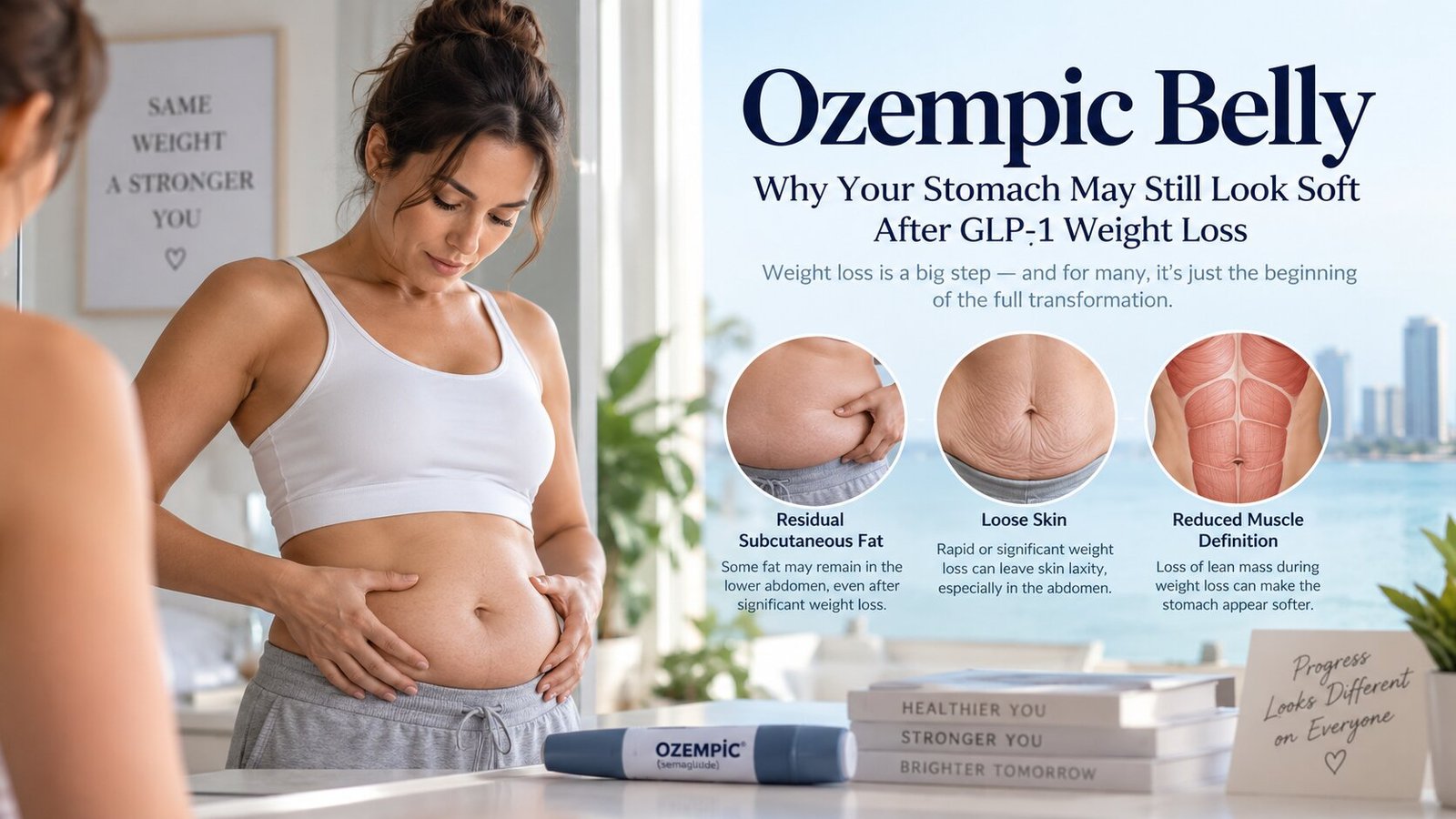
Losing weight with Ozempic or another GLP-1 medication can feel like a major turning point. Clothes fit differently, your energy may improve, and the number on the scale can finally reflect years of effort. Yet there is a frustrating moment some people encounter after substantial weight loss: they reach a much lower weight but look in the mirror and still see a soft lower stomach, stubborn fullness around the waist, or skin that seems looser than expected. If that sounds familiar, you are not alone. The appearance sometimes called “Ozempic belly” can be confusing because successful weight loss does not necessarily mean every part of your body will become firm, flat, or defined at the same rate.
At TruSculpt Miami, this distinction is important when evaluating patients after GLP-1 weight loss. A person can lose 20, 30, 40 pounds, or substantially more and still have a small amount of pinchable abdominal fat. Someone else may have relatively little remaining fat but noticeable skin laxity. Another person may have experienced a reduction in muscle mass during their weight-loss journey, leaving the midsection looking softer despite a dramatic improvement in overall body weight. These situations can look similar from the outside, but they are not the same problem and should not automatically be treated the same way.
It also helps to remember that “Ozempic belly” is an informal description, not a medical diagnosis. Ozempic itself is not a magic switch that specifically targets abdominal fat, nor does a soft stomach mean the medication has failed. Weight loss, fat reduction, skin tightening, and muscle definition are different goals. Once you understand that difference, the next step becomes much clearer: identify what is actually contributing to the abdominal appearance and then choose an approach that matches the tissue being treated.
What Is “Ozempic Belly”?
The phrase “Ozempic belly” is commonly used online and in everyday conversations to describe a stomach that still appears soft, loose, or disproportionately full after significant weight loss associated with a GLP-1 medication. The phrase can refer to several different physical changes, which is one reason it can be misleading. Two people may both say they have an “Ozempic belly,” while one has a localized pocket of subcutaneous fat and the other primarily has loose skin. A third person may have a combination of both along with less abdominal muscle definition than they had before losing weight.
GLP-1 medications such as semaglutide can produce substantial weight reduction in appropriately selected patients, but they do not control exactly where the body loses fat first. Human bodies are not sculpted according to a perfectly predictable blueprint. Genetics, age, sex, hormones, previous weight changes, activity level, nutrition, and individual fat distribution all influence the way the body changes during weight loss. You may lose noticeable volume from your face and upper body while your lower abdomen changes much more slowly. That can make the remaining abdominal tissue seem particularly stubborn, even when your overall transformation has been significant.
There is another important point: the abdomen is not made of fat alone. The visible shape of your stomach is influenced by skin, subcutaneous fat, deeper abdominal structures, and the muscles underneath the abdominal wall. If one component changes dramatically while another changes only modestly, your final appearance may not match the image you had in mind when you started treatment. Losing the weight can be the first chapter rather than the final chapter of a body-transformation journey.
Why the Term Can Be Misleading
Calling the appearance “Ozempic belly” can make it sound as though there is one specific condition caused by Ozempic. That is not necessarily what is happening. A soft abdomen after weight loss may have several contributors, and the right solution depends on which contributor is most significant.
The "Winter Coat" Analogy
Imagine removing a heavy winter coat and discovering that the shirt underneath still hangs loosely. The coat represented excess body weight, but removing it does not automatically reshape the shirt. In a similar way, losing substantial body weight reduces the overall amount of tissue your body carries, but your skin and underlying structures may not instantly conform to their new dimensions. Some patients also retain localized subcutaneous fat that becomes more noticeable after the surrounding areas become smaller.
That is why an individualized assessment is more useful than focusing on the label. The practical questions are: How much fat remains? How much skin laxity is present? Is the remaining tissue pinchable? Has muscle volume changed? Is your weight stable? What outcome are you actually trying to achieve? Those questions can help distinguish someone who may benefit from non-surgical body contouring from someone who would be better served by continued medical weight management, strength training, or a surgical consultation.
Why Can Your Belly Still Look Soft After Losing Weight?
There is rarely one universal explanation for a soft stomach following major weight loss. In many cases, several changes happen simultaneously. You may have successfully reduced total body fat while retaining a small amount of subcutaneous abdominal fat. Your skin may have stretched during years of higher body weight and may now appear less taut. At the same time, some lean tissue can be lost during significant weight reduction, particularly when resistance exercise and adequate nutrition are not adequately incorporated into the process.
This is why the scale can sometimes tell only part of the story. Imagine two people who each weigh 150 pounds. One might have a higher proportion of muscle and relatively little subcutaneous fat, while the other could have less muscle and a different distribution of body fat. Their scale weight is identical, but their silhouettes can look completely different. Body composition matters, especially when the goal shifts from losing weight to creating a more defined shape.
Remaining Subcutaneous Belly Fat
One of the simplest explanations is that you may still have subcutaneous belly fat after losing weight. Subcutaneous fat is the layer located directly underneath the skin, and it is generally the type of abdominal fat you can pinch between your fingers. GLP-1 treatment can contribute to substantial reductions in total fat mass and improvements in fat distribution, but it does not provide spot reduction.
That distinction is crucial. You cannot tell your body, “Take the next five pounds from my lower stomach and leave everything else alone.” Fat loss is regulated by complex biological factors, and different areas can respond differently as your weight changes. Some people notice their waist shrinking quickly, while others find that a lower-abdominal pocket or the area around the flanks seems to remain long after other areas have changed.
Once someone gets closer to their desired weight, a relatively small pocket of remaining fat can become much more visible. It may have been difficult to notice when there was more overall abdominal volume. After losing significant weight, however, that same pocket can stand out because the rest of the body has become smaller.
This is where body contouring after Ozempic may become relevant for appropriately selected patients. The objective is not to recreate the weight-loss process or dramatically change the number on the scale. Instead, localized contouring can be considered when a patient is already relatively close to their goal and has a specific area of subcutaneous fat that remains resistant to diet and exercise.
Weight Loss vs. Fat Reduction
Although people often use “weight loss” and “fat loss” interchangeably, they are not identical. Your total body weight includes fat, lean tissue, water, bone, organs, and other components. When your weight decreases, the composition of that loss can vary from person to person and over time.
GLP-1 medications are designed to support meaningful overall weight reduction in appropriate patients, particularly when combined with nutritional and lifestyle measures. Non-surgical body contouring serves a different purpose. It is generally considered a cosmetic approach for localized areas of unwanted subcutaneous fat in people who are already relatively close to their desired weight.
That means body contouring should not be viewed as an alternative to medically appropriate weight management. If someone still has substantial weight to lose, addressing overall health and weight management generally comes first. But when a person has achieved a healthier weight and is left with one stubborn area, the conversation can shift from “How much more weight should I lose?” to “What is creating this particular contour?”
That change in perspective can prevent a common mistake: continuing to pursue a lower scale weight simply because the abdomen has not become as flat as expected. Sometimes additional weight loss makes the face, arms, legs, or other areas smaller without eliminating the specific abdominal pocket. The desired result may therefore depend more on body composition and contour than on another reduction in total body weight.
Muscle Loss vs. Lean Mass During GLP-1 Weight Loss
Another piece of the puzzle is understanding changes in body composition. Significant weight loss involves reductions in both fat mass and lean tissue, although the amount varies substantially among individuals and depends on factors such as baseline body composition, protein intake, resistance training, and the rate of weight loss.
It is clinically essential to distinguish between lean mass (often termed fat-free mass) and skeletal muscle mass. On body-composition assessments like DXA scans or bioelectrical impedance, "lean mass" includes skeletal muscle, vital organs, bone mineral content, and total body water. A notable portion of the early decline in lean mass during GLP-1 therapy represents changes in fluid volume and intracellular glycogen stores rather than direct contractile muscle loss. Nonetheless, true skeletal muscle loss can occur when calorie deficits are steep and resistance exercise or protein intake is lacking.
Recent research on incretin-based therapies highlights this relationship. A systematic review and meta-analysis on body composition changes with GLP-1 receptor agonists (Sargeant et al., Diabetes Obes Metab) demonstrated that lean mass accounted for a meaningful proportion of weight lost during treatment, while progressive resistance exercise was strongly associated with preserving functional lean mass. This reinforces why protecting skeletal muscle through progressive resistance training and adequate dietary protein deserves primary clinical attention during GLP-1 therapy.
Why does that matter for your stomach? Because the appearance of your midsection is not determined by the layer of fat above your abdominal muscles alone. Changes in muscle volume, conditioning, and core stability affect how firm and defined the area appears. Someone can become considerably leaner but still feel that their stomach looks “soft” or distended because underlying abdominal wall muscle tone has lessened.
This is why progressive resistance exercise, targeted protein intake (typically 1.2–1.6 g/kg daily when clinically appropriate), and medically supervised nutrition are the primary medical pillars of weight-loss preservation. The goal is not simply to make the number on the scale smaller, but to protect metabolic rate, strength, physical function, and healthy body composition.
Loose Skin After Major Weight Loss
Loose skin is another common reason the abdomen may look different after substantial weight loss. Skin is living tissue with elasticity and structural proteins that allow it to stretch and recoil, but its ability to contract after major changes in body size varies considerably from person to person.
Think about a balloon after it has been inflated for a long time. Once the air is released, the balloon becomes smaller, but it may not return to exactly the same shape or tension it had before inflation. Human skin is far more complex than a balloon, of course, but the analogy helps explain why substantial weight reduction does not guarantee that every area will immediately look tight.
Age, genetics, the amount and duration of previous weight gain, pregnancy, sun exposure, smoking, and overall skin quality can all influence how much skin remains after weight loss. Someone who has lost a relatively modest amount of weight may experience little laxity, while someone who has undergone a much larger transformation may notice folds, crepey texture, or hanging tissue.
This distinction becomes especially important when discussing non-surgical fat reduction in Miami. A treatment designed to target localized fat should not be presented as an equivalent substitute for removing significant excess skin. If the dominant concern is substantial skin redundancy, a consultation with an appropriately qualified plastic surgeon may be more appropriate.
Visceral Fat vs. Subcutaneous Fat
Understanding the difference between visceral fat and subcutaneous fat can make the entire conversation about post-GLP-1 abdominal changes easier to understand. Subcutaneous fat sits beneath the skin and is generally the soft, pinchable tissue that contributes to a localized bulge. Visceral fat, by contrast, is stored deeper within the abdominal cavity around internal organs.
| Feature | Subcutaneous Fat | Visceral Fat |
|---|---|---|
| Location | Directly under the skin | Deep in the abdominal cavity around organs |
| Texture / Feel | Soft, pinchable between fingers | Firm, causes abdomen to push outward |
| Health Impact | Primarily cosmetic, less metabolic risk | Associated with cardiovascular & metabolic risk |
| Response to GLP-1 | Decreases with overall fat loss (spot-resistant) | Often reduces early with systemic weight loss |
| Treatment Approach | truSculpt iD / Non-surgical body contouring | Medical weight management, diet & exercise |
These two types of fat behave differently and have different implications. Visceral fat is particularly relevant to metabolic health and is associated with conditions such as insulin resistance and cardiometabolic disease. Subcutaneous fat can also be metabolically relevant, but from a cosmetic body-contouring perspective, localized superficial fat is generally the more relevant target.
GLP-1-based weight-loss therapies can reduce overall adiposity, including visceral and subcutaneous fat. That is one reason these medications can be so valuable as part of appropriate medical weight management. However, reducing visceral fat does not guarantee that every visible pocket of superficial abdominal fat will disappear.
A patient can therefore be significantly healthier and substantially leaner while still having a lower-abdominal area they would like to refine. That does not mean the medication did not work. It means the health-related weight-loss phase and the cosmetic contouring phase are addressing different objectives.
Why the Difference Matters for Treatment
This distinction matters because a cosmetic device should not be positioned as a treatment for deep abdominal visceral fat. If the primary issue is visceral adiposity, the focus should remain on medical weight management, physical activity, nutrition, and other evidence-based strategies appropriate to the individual's health.
By contrast, if a patient is relatively weight stable and has a localized, pinchable area of subcutaneous fat, a body-contouring consultation may be reasonable. The first step is determining what is actually present rather than assuming every soft stomach is simply “belly fat after Ozempic.”
That assessment can also reveal when a non-surgical treatment is unlikely to provide the desired outcome. If a patient has considerable loose skin, for example, reducing a small amount of underlying fat may not create the dramatic tightening effect they expect. Honest treatment planning means matching the intervention to the anatomy.
What Can You Do About Belly Fat After Ozempic?
If you have lost substantial weight and still dislike the appearance of your stomach, the first move does not have to be another round of aggressive weight loss. Instead, consider what you are actually seeing. Is there a soft, localized pocket that you can pinch? Is the skin loose or crepey? Does the abdomen feel generally soft because muscle definition has decreased? Or is there still significant overall weight or central adiposity that would make continued medical management more appropriate?
At TruSculpt Miami, those distinctions can help guide a personalized conversation. A body-contouring evaluation may consider your weight stability, the amount and distribution of subcutaneous fat, skin laxity, muscle condition, medical history, and desired outcome. The goal is to determine whether the concern is primarily fat, skin, muscle, or some combination.
For an individual who is still actively losing substantial weight, waiting may be appropriate. Your body can continue changing as your weight changes, and contouring decisions made too early may not reflect your eventual shape. Someone who has reached a relatively stable weight and is primarily concerned with a small localized pocket may be in a very different position.
There is also no requirement to pursue treatment simply because a technology exists. Sometimes the best recommendation is to continue strength training, maintain nutrition, allow your weight to stabilize, and reassess later. A good body-contouring plan should fit into your broader health journey rather than compete with it.
Can truSculpt Help With Stubborn Belly Fat After GLP-1 Weight Loss?
Once you have lost substantial weight with Ozempic, Wegovy, Mounjaro, Zepbound, or another medically supervised GLP-1 program, your priorities may change. Early in the journey, the main objective is usually reducing excess body weight and improving overall health. Later, when you are closer to your goal, the question can become more specific: Why is this one area still bothering me when I have already made so much progress? For appropriately selected patients, non-surgical body contouring can be one option worth discussing, particularly when the remaining concern is a localized pocket of subcutaneous fat rather than significant excess skin or visceral fat.
truSculpt iD is a radiofrequency-based body-contouring technology designed to treat targeted areas of subcutaneous tissue. Unlike a GLP-1 medication, it is not intended to produce systemic weight loss. The purpose is more localized: helping improve the contour of an area where stubborn superficial fat remains. That distinction is important because body contouring should not be marketed as another way to lose a large amount of weight. Think of GLP-1 therapy as changing the overall landscape, while body contouring may be used to refine a particular part of that landscape once the larger transformation is underway.
For someone considering truSculpt Miami after GLP-1 weight loss, expectations matter. A non-surgical contouring procedure is not designed to reproduce the dramatic scale changes that can occur with medical weight management, and individual responses vary. It also cannot remove significant amounts of loose, hanging skin. The strongest candidates are generally people who are relatively close to their desired weight, have a localized area of pinchable subcutaneous fat, and want a modest contour improvement rather than a major weight-loss intervention. A consultation can help determine whether the abdomen, lower belly, flanks, or another area is appropriate for treatment and whether another approach would make more sense.
How truSculpt iD Works for Body Contouring
truSculpt iD uses radiofrequency energy to deliver controlled heating to targeted tissue. The technology is intended for non-surgical body contouring, making it fundamentally different from liposuction or surgical excision. There are no incisions involved in the treatment, which is one reason non-invasive or non-surgical options can appeal to people who are not looking for a surgical procedure.
Still, “non-surgical” does not mean “one-size-fits-all.” The appropriate treatment area, candidacy, expected outcome, and safety considerations should be determined by a qualified professional. Someone with a small amount of localized abdominal fat may have a very different experience and treatment plan from someone with extensive skin laxity following a major weight reduction.
For patients in Miami, the appeal can be particularly straightforward: they may have already done the difficult work of losing significant weight and simply want to refine a stubborn area without undergoing surgery. Body contouring after Ozempic can therefore be viewed as a potential finishing step for selected patients—not as a replacement for the medical weight-loss process that came before it.
What About Muscle Definition After Weight Loss?
Fat is only one part of the visual equation. If you have ever looked at two people with similar body weights and wondered why their physiques look completely different, muscle is part of the answer. The amount of muscle you carry, where it is distributed, and how well conditioned it is can influence the shape and firmness of your body. This becomes particularly relevant after substantial GLP-1 weight loss because some patients experience changes in lean mass along with reductions in fat.
That does not mean every person taking a GLP-1 medication will lose excessive muscle. The amount of lean tissue lost varies, and the research continues to evolve. But it does mean that a successful weight-loss program should ideally pay attention to more than the scale. Preserving strength and lean mass can be just as important as reducing body weight, particularly for people who are pursuing long-term health rather than simply a lower number.
Your abdomen illustrates this beautifully. If you lose a substantial amount of fat but also have less abdominal muscle volume or conditioning, your stomach may not automatically develop the firm, athletic appearance you expected. You might be significantly healthier and considerably leaner but still describe your abdomen as “soft.” That is not necessarily a sign that you need to lose another 10 or 20 pounds.
This is where resistance training becomes an important part of the conversation. Strength training can help support lean-mass preservation during weight loss, while adequate nutrition—including sufficient protein when medically appropriate—can support the body's ability to maintain muscle. These strategies are not cosmetic tricks; they are part of a broader approach to maintaining physical function and body composition.
At the same time, some patients seeking aesthetic refinement may want additional localized abdominal muscle conditioning. That is where technologies such as truFlex may be considered for appropriately selected individuals. However, it is essential to emphasize that truFlex is an FDA-cleared bio-electrical muscle stimulation device indicated for strengthening, toning, and firming abdominal muscles—it is not clinically proven or indicated to prevent or treat medication-related systemic muscle loss, sarcopenia, or metabolic lean-mass depletion. Systemic muscle protection requires active resistance exercise and physician-guided nutrition; truFlex serves strictly as a non-surgical aesthetic adjunct for localized tone and core firming in qualified candidates.
truSculpt + truFlex After GLP-1 Weight Loss
For some patients, the post-weight-loss abdomen presents more than one aesthetic factor. There may be a small amount of remaining subcutaneous fat on top, while reduced muscle definition underneath contributes to the softer appearance. Treating only one component may leave part of the cosmetic concern unchanged. A combined approach using truSculpt iD and truFlex may be considered when both localized subcutaneous fat and localized muscle conditioning are appropriate to the patient's anatomy.
The truBody Dual-Layer Protocol
The concept is relatively simple. truSculpt is focused on body contouring and targeted subcutaneous fat reduction using monopolar RF, while truFlex is designed around multi-directional bio-electrical muscle stimulation and conditioning. The two approaches address different anatomical layers of the body, which can make the combination appealing for selected post-weight-loss patients. At TruSculpt Miami, this broader strategy may be discussed as part of a personalized truBody approach.
That does not mean everyone needs both treatments. Some people may have adequate muscular conditioning already and simply want to address a small area of residual subcutaneous fat. Others may have little remaining fat but want to focus on abdominal muscle conditioning. Someone with significant excess hanging skin may need a referral for plastic surgery rather than non-surgical devices. The goal is never to stack treatments indiscriminately, but to evaluate what anatomical layer is driving the concern.
It is equally important to maintain realistic expectations. A body-contouring treatment is not a shortcut around nutrition, physical activity, or medically appropriate weight management. Crucially, non-invasive muscle stimulation should never be portrayed as a replacement for active resistance exercise. Technology can serve as an aesthetic adjunct in a broader wellness plan, but it cannot replace active physical training or clinical nutrition.
The most useful question is therefore not, “Which device should I get?” It is, “What is responsible for the appearance I want to change?” Once that is answered, treatment selection becomes much more logical.
Should You Keep Losing Weight to Get Rid of Your Belly?
This is one of the most important questions to ask before pursuing additional weight loss. If you are still medically overweight, have significant central adiposity, or have a health-related reason to continue losing weight, your physician may recommend continuing your medically supervised plan. But if you have already reached a healthy or appropriate weight and the only remaining concern is a small abdominal pocket, trying to make the scale keep moving downward may not give you the result you want.
Why? Because your body does not take every additional pound from the area you have selected. You might lose more volume from your face, arms, legs, or other areas while that stubborn lower-abdominal area barely changes. At some point, the pursuit of a smaller scale number can become disconnected from the actual cosmetic goal.
This is why body composition after GLP-1 weight loss deserves attention. A person can be at a perfectly reasonable weight and still have a body shape they would like to refine. Conversely, someone can be very lean but have relatively little muscle, making the body appear softer than expected. There is no single scale number that guarantees a flat stomach because body shape is influenced by far more than body weight.
Instead of asking only, “How much more can I lose?” it may be more useful to ask, “Am I at a weight I can maintain while feeling healthy and strong?” and “What specifically is preventing my abdomen from looking the way I want?”
- If the answer is a localized pocket of subcutaneous fat: Body contouring with truSculpt iD may be worth discussing.
- If the answer is loose, redundant skin: A plastic surgery consultation for skin excision may be necessary.
- If the answer is reduced muscle conditioning: Resistance training and truFlex muscle stimulation may be more relevant.
- If the answer is ongoing overall weight or visceral adiposity: Medical weight management remains central.
How to Protect Muscle While Using GLP-1 Medications
A successful GLP-1 weight-loss journey should ideally involve more than watching the scale fall. As body weight decreases, preserving physical strength and lean mass can become an important part of the process. This is especially relevant for adults who are older, physically inactive, or losing a substantial amount of weight, because maintaining muscle supports everyday activities such as walking, climbing stairs, lifting objects, and getting up from a chair.
Resistance training is one of the most practical tools available. Depending on your health status and fitness level, that could mean working with weights, resistance bands, machines, or appropriately challenging bodyweight exercises. The goal is progressive resistance rather than simply doing endless cardio. A qualified fitness professional or healthcare provider can help determine what type and amount of training are appropriate for you.
Nutrition matters as well. During significant weight loss, eating enough protein and maintaining adequate overall nutrition can be important for supporting lean tissue. Individual protein needs can vary based on age, body size, kidney health, activity level, and other medical factors, so personalized guidance is preferable to blindly following a high-protein target found online.
There is also a psychological benefit to shifting the focus from weight alone to strength and body composition. If the only measure of success is the scale, you can miss other meaningful improvements. Being able to lift more, walk farther, feel stronger, and maintain a healthier body composition can all represent progress.
And if your weight has stabilized but your body still does not look as defined as you expected, that does not automatically mean the GLP-1 medication “did something wrong.” It may simply mean the next phase of your journey involves a different goal.
When Should You Consider Body Contouring After Ozempic?
Timing matters. If your body weight is still changing rapidly, the abdomen you see today may not be the abdomen you have several months from now. For someone who expects to lose another substantial amount of weight, it can make sense to focus on medical weight management first and revisit contouring after the body has had an opportunity to settle.
There is no universal number of weeks or months that makes someone automatically ready. Instead, candidacy should be considered in the context of weight stability, overall health, tissue characteristics, and personal goals. A person who has been near their goal weight for a period of time and has one persistent pocket of pinchable abdominal fat may be a more logical candidate than someone who is still in the middle of a major weight-loss phase.
Potentially favorable characteristics may include:
- Being close to your desired body weight
- Having maintained a relatively stable weight for 3 to 6 months
- Having localized subcutaneous fat rather than primarily visceral fat
- Having good skin elasticity with mild laxity rather than large skin aprons
- Having realistic expectations about non-surgical body contouring outcomes
Skin quality also matters. If the abdomen has significant folds or hanging excess skin, a fat-reduction treatment may not address the feature that bothers you most. In those situations, an evaluation by a plastic surgeon may be more appropriate.
The consultation is therefore not simply about deciding whether you want treatment. It is about deciding whether treatment makes sense for your particular anatomy at this particular point in your weight-loss journey.
When truSculpt May Not Be the Right Answer
A responsible body-contouring practice should be willing to say when a treatment is not the best fit. Not every post-weight-loss abdomen is a candidate for truSculpt, and not every cosmetic concern is caused by superficial fat.
For example, someone with substantial hanging abdominal skin after major weight loss may need to explore surgical options. A non-surgical contouring treatment cannot simply remove a large apron of redundant skin. If the dominant issue is visceral fat, localized external body contouring is also not the appropriate tool because visceral fat sits deep inside the abdominal cavity.
Timing can also make treatment inappropriate. If you are still losing substantial weight, your body is still changing. Waiting until your weight and overall shape are more stable may produce a more sensible basis for deciding whether contouring is worthwhile.
There are also individual health considerations that need to be reviewed before any procedure. Medical history, medications, pregnancy considerations, implanted devices, skin conditions, and other factors can influence candidacy and treatment planning. That is why an individualized consultation is more valuable than choosing a procedure based solely on an online description.
The goal should always be to match the treatment to the problem. If another option has a better chance of achieving your desired result, that should be part of the conversation.
From Weight Loss to Body Composition
GLP-1 medications have changed the way many people approach weight management. For appropriate patients, they can make substantial weight reduction more achievable, particularly when paired with nutrition and physical activity. But once the weight comes off, another question emerges: What does the new body composition look like?
That question is becoming increasingly important as clinicians and researchers study the effects of incretin-based therapies. Research generally demonstrates meaningful reductions in adiposity with GLP-1-based treatment, while the amount of lean-mass change varies across studies and individuals. This reinforces the importance of resistance training, appropriate nutrition, and attention to strength throughout the weight-loss process.
For some patients, the next stage is not another aggressive push toward a lower scale weight. It may be about maintaining the weight they have achieved while improving strength and refining specific areas that still bother them. That can include addressing a localized pocket of subcutaneous fat, improving muscle conditioning, or determining whether loose skin is the primary issue.
“Think of it like renovating a house. Losing excess weight may be the major renovation that changes the entire structure. Body contouring, muscle conditioning, and aesthetic refinement are the finishing work. You do not use the same tool to rebuild a wall that you use to polish the final surface.”
That is ultimately why Ozempic belly after weight loss deserves a more nuanced conversation than simply asking whether Ozempic causes a stomach to look soft. The answer depends on what remains after the weight comes off.
Body Contouring After Ozempic in Miami
If you have successfully lost weight with Ozempic, Wegovy, Mounjaro, Zepbound, or another medically supervised GLP-1 program but still feel frustrated by your abdominal appearance, you do not necessarily need to return to the scale for the answer. Your remaining concern may be a small amount of subcutaneous fat, skin laxity, reduced muscle definition, or a combination of several factors.
At TruSculpt Miami, the starting point is understanding those differences. An individualized evaluation can help determine whether your concern is primarily localized fat, skin, muscle, or overall body composition. Depending on your anatomy and goals, potential options may include truSculpt iD, truFlex, a combined truBody approach, continued medical weight management, strength-focused strategies, or referral for another treatment when appropriate.
For patients interested in non-surgical fat reduction in Miami, the most important thing is to have realistic expectations. Body contouring is about refining shape rather than replacing weight-loss treatment. It is not a treatment for obesity or deep visceral fat, and it is not a substitute for surgical removal of substantial excess skin.
Your weight-loss accomplishment deserves to be recognized for what it is. If you are healthier and lighter but still want to refine your abdomen, the next step may simply involve understanding your body from a different perspective—one that considers fat, muscle, skin, and contour together rather than focusing exclusively on pounds.
Conclusion
The term “Ozempic belly” may sound like a single condition, but a soft stomach after GLP-1 weight loss can have several different explanations. Remaining subcutaneous fat, loose skin, changes in lean mass, and reduced muscle definition can all influence the way the abdomen looks after significant weight reduction. That is why losing more weight is not automatically the answer.
For appropriately selected patients who are near a stable goal weight and have localized stubborn abdominal fat, body contouring after Ozempic may be worth exploring. Treatments such as truSculpt iD can be considered for targeted subcutaneous fat, while truFlex may be considered when muscle conditioning is also part of the goal. Patients with significant skin redundancy or other concerns may need a different treatment strategy.
The key is to stop treating the scale as the only measure of success. A healthier, stronger body is about more than a number. If you have completed a major GLP-1 weight-loss journey and want to understand why your stomach still looks soft, a personalized evaluation can help identify what is actually contributing to the appearance and which options, if any, are appropriate.
Frequently Asked Questions About Ozempic Belly
Medical References & Scientific Sources
- • Sargeant JA, Hens W, King JA, Yates T, Nimmo MA, et al. A review of the effects of glucagon-like peptide-1 receptor agonists and sodium-glucose cotransporter 2 inhibitors on lean body mass in humans. Diabetes Obes Metab. 2019;21(7):1531-1542.
- • Wilding JPH, Batterham RL, Calanna S, et al. (STEP 1 Trial). Once-Weekly Semaglutide in Adults with Overweight or Obesity. N Engl J Med. 2021;384(11):989-1002.
- • Cutera Inc. truSculpt® iD and truFlex® Clinical Operator Manuals & Indications for Use.
Medical Disclaimer
This article is provided for educational purposes and is not a substitute for individualized medical advice, diagnosis, or treatment. GLP-1 medications should be used under appropriate medical supervision. Body-contouring treatment suitability varies by patient, and individual results are not guaranteed. Discuss your medical history, medications, goals, and treatment options with a qualified healthcare professional.