If you have been working toward a healthier body, you may have noticed something frustrating: losing weight does not always change the shape of your body in the way you expected. Perhaps your weight has become more stable, but you still notice fullness around your abdomen or flanks. Or maybe you want to improve your overall health and are unsure whether a medical weight-management program or a nonsurgical body-contouring treatment makes more sense.
These concerns raise an important question: What is the difference between body contouring and weight loss, and which approach is right for you?
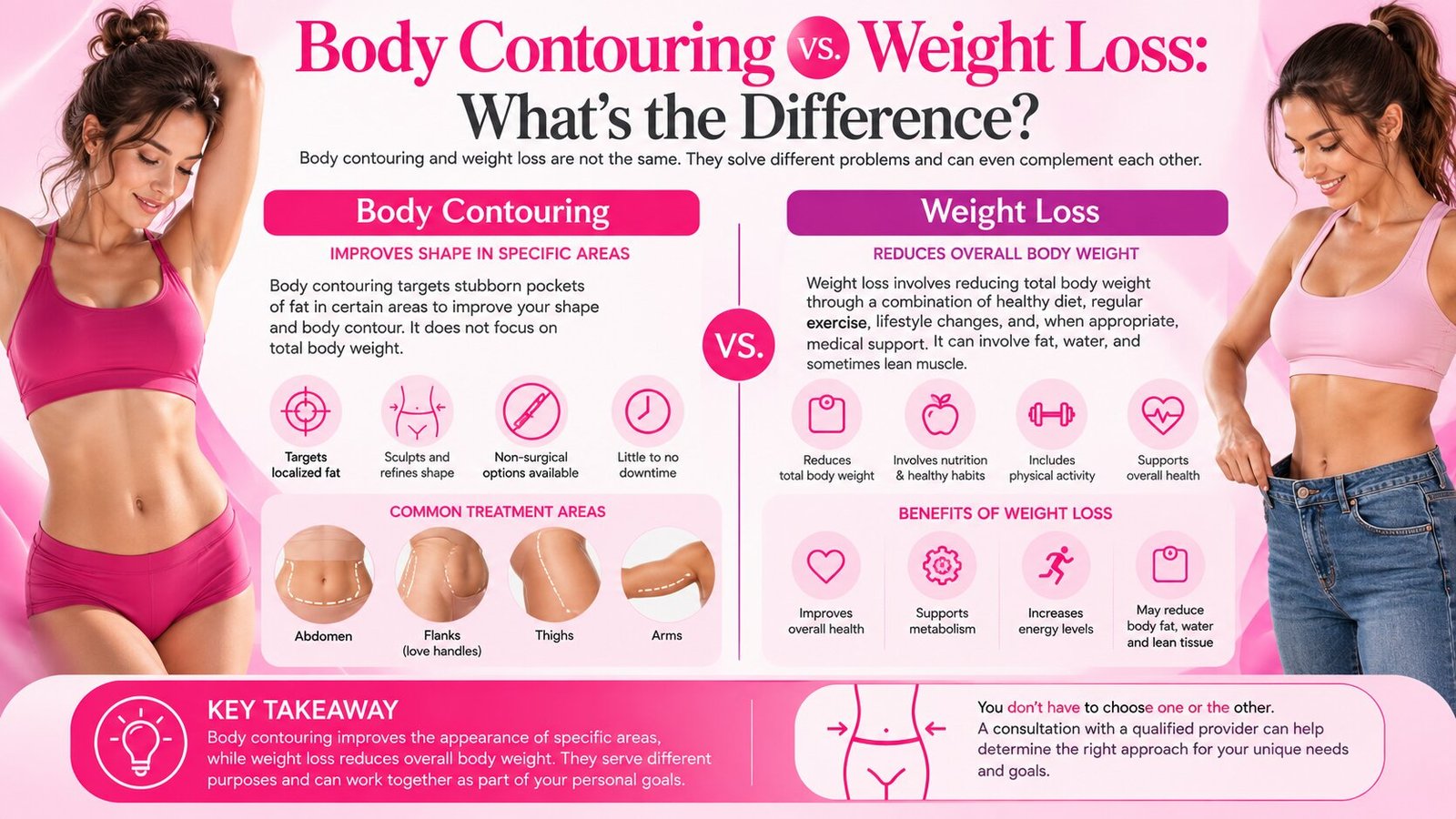
Although people sometimes use these terms interchangeably, they describe different goals. Weight loss focuses on reducing overall body weight, often with the additional objective of improving weight-related health risks. Body contouring, by comparison, is designed to improve the appearance or circumference of a selected area by addressing localized fat beneath the skin.
At TruSculpt Miami, understanding this distinction helps patients explore treatments with realistic expectations. Nonsurgical body contouring may be worth considering for certain localized areas, while people seeking substantial weight reduction may benefit more from lifestyle changes, medical evaluation, prescription treatment when appropriate, or other evidence-based weight-management options.
Key Takeaway
Weight loss changes overall body mass, while body contouring focuses on the shape of a specific area. Neither approach is automatically better than the other. The right choice depends on your health, anatomy, goals, and the reason a particular area concerns you.
Body Contouring and Weight Loss Solve Different Problems
It is easy to assume that every treatment advertised for fat reduction should also help you lose weight. After all, if a treatment reduces fat in a particular area, shouldn't your weight decrease, too? Not necessarily. The amount of tissue affected by a localized cosmetic treatment is relatively small compared with the total mass of the body, so even a visible change in contour may have little effect on the number displayed on a scale.
Weight loss has a broader purpose. It involves reducing overall body weight through sustained changes in energy balance, healthy behaviors, and, when medically appropriate, additional interventions. Depending on the person and the method used, the change may involve body fat, water, and lean tissue. A comprehensive weight-management plan considers not only weight but also nutrition, physical activity, sleep, medications, underlying health conditions, and the preservation of muscle.
Body contouring takes a more focused approach. Instead of trying to change the body's total weight, it aims to improve the appearance of a selected treatment area. For example, someone whose weight has remained reasonably stable may still have localized fullness around the abdomen or flanks. If the concern is caused by suitable subcutaneous fat, a clinician may determine that a nonsurgical treatment is an option.
Body Contouring vs. Weight Loss at a Glance
| Consideration | Weight Loss | Nonsurgical Body Contouring |
|---|---|---|
| Primary Goal | Reduce overall body weight and address weight-related health concerns when indicated | Improve the contour and circumference of a selected area |
| Main Focus | Total body mass and overall fat mass | Localized subcutaneous fat in an appropriate treatment area |
| Expected Scale Change | Usually measurable when treatment is effective | Often small or not clinically meaningful on the scale |
| Visceral Fat | May decrease with effective weight loss | Not directly treated by body-contouring devices |
| Typical Timing | When overall weight reduction is the primary goal | Often considered after weight becomes reasonably stable |
| Treatment Options | Lifestyle care, medical evaluation, medication, or surgery for selected patients | Device-based treatments (truSculpt) following clinical assessment |
| Maintenance | Sustainable habits and appropriate medical follow-up | Weight stability and healthy habits help maintain contour |
| Main Limitation | Weight loss does not guarantee that every localized contour will change as desired | Contouring does not treat obesity or replace weight management |
Neither approach should be selected solely because of a number on the scale or a photograph of someone else's results. A person may benefit from weight management, body contouring, or a combination of approaches at different stages. In other cases, a different treatment or no cosmetic procedure may be the most appropriate recommendation.
The first step is to identify the outcome you actually want. Are you trying to improve overall health, reduce substantial excess weight, or address a specific area that remains prominent despite weight stability? Answering that question makes the next decision considerably clearer.
What Does Weight Loss Actually Change?
Weight loss occurs when the body uses more energy over time than it receives from food and beverages, but that explanation only tells part of the story. Human metabolism is influenced by genetics, hormones, sleep, medications, health conditions, activity levels, and previous weight changes. Two people can follow similar routines and experience different results, which is why effective weight management should be individualized rather than built around a one-size-fits-all promise.
For some people, sustainable changes in eating patterns and physical activity provide a useful foundation. Others may need additional medical support because of obesity, weight-related health risks, medication effects, or difficulties maintaining previous results. A healthcare professional can help assess these circumstances and determine which options are appropriate.
A physician-supervised weight management program may consider your weight history, nutrition, exercise habits, sleep quality, stress, medications, metabolic health, and previous treatment attempts. Depending on your circumstances, the plan may include prescription anti-obesity medication or referral for bariatric treatment. These options require individualized evaluation; they are not necessary or suitable for everyone.
The National Institute of Diabetes and Digestive and Kidney Diseases (NIDDK) emphasizes sustainable eating patterns and physical activity as important parts of losing weight and maintaining weight loss. That advice also highlights a distinction between short-term weight change and long-term success. A plan that produces a quick reduction but cannot be maintained may not serve your health goals as well as a sustainable approach.
Why Overall Weight Loss Is Different From Localized Fat Reduction
When overall weight decreases, both subcutaneous fat and visceral fat may decrease, although the amount and distribution of change vary between individuals. Weight loss can also involve lean tissue, including muscle. Preserving muscle is particularly important during significant or rapid weight reduction, because muscle supports strength, mobility, and everyday function.
Nutrition, adequate protein intake when appropriate, resistance exercise, and clinical monitoring may help support muscle preservation. These considerations can be especially relevant for people using GLP-1-based medications or other treatments associated with substantial weight changes. (Learn more about GLP-1 weight loss and muscle support). The appropriate strategy depends on individual health needs, so medication changes and nutrition concerns should be discussed with the treating clinician.
Another important point is that weight loss does not guarantee that every part of the body will change at the same rate. Genetics, skin elasticity, age, previous weight fluctuations, and body composition all influence the final appearance. Someone may reach a healthier, stable weight and still notice localized abdominal fullness or loose skin.
That does not automatically mean more weight loss is necessary. Sometimes the remaining concern is related to subcutaneous fat, sometimes it involves skin laxity or muscle tone, and sometimes the appearance has little to do with fat at all. Determining the cause is more useful than assuming that the scale needs to move lower.
What Does Body Contouring Actually Change?
Body contouring is designed to improve the shape or circumference of a selected area rather than produce substantial weight loss. Nonsurgical technologies use different methods, including controlled cooling, heating, ultrasound, or other forms of energy, depending on the specific device. The treatment method, eligible areas, and expected outcomes vary, so results associated with one technology should not automatically be attributed to another.
At TruSculpt Miami, truSculpt uses radiofrequency energy for selected body-contouring applications. Specific FDA-cleared configurations have indications that include noninvasive lipolysis and reduction in abdominal circumference. The applicable indication depends on the device configuration and its labeling, and treatment must be planned according to the manufacturer's instructions and the patient's clinical assessment.
It is important to distinguish an improvement in localized contour from meaningful weight reduction. A treatment may change how an area looks or how clothing fits without producing a significant difference on the scale. The amount of tissue affected is small relative to total body mass, and body-contouring procedures are not designed to provide the broad health benefits associated with treating obesity.
The U.S. Food and Drug Administration advises that noninvasive body-contouring procedures do not treat obesity and should not be viewed as substitutes for medical weight management. Some patients may need more than one treatment to pursue their desired result, while others may not experience the degree of change they expected. A consultation should explain these possibilities before treatment begins.
How Radiofrequency Body Contouring Works
Radiofrequency body-contouring devices deliver controlled energy to the targeted treatment area. The intended effect depends on the device, its configuration, the treatment settings, and the manufacturer's cleared or authorized indications. For truSculpt, the goal is to address selected areas of localized fat rather than reduce total body weight.
A suitable treatment plan begins with identifying the tissue responsible for the concern. If the area contains localized subcutaneous fat and otherwise meets the relevant treatment criteria, the clinician can assess whether radiofrequency contouring may be appropriate. If the main concern is significant loose skin, abdominal-wall separation, a hernia, or deeper visceral fat, another approach may be needed.
Patients should also understand that nonsurgical does not mean completely risk-free. Temporary warmth, tenderness, redness, swelling, bruising, or altered sensation may occur, depending on the technology and the individual. Less common or more persistent complications are possible, so personal medical history, medications, sensation, circulation, and implanted devices may need to be reviewed.
It is equally important to avoid assuming that every radiofrequency device has the same evidence, settings, or approved uses. A clinician should explain which device will be used, what its labeling supports, what evidence is available, and what outcome is realistic for the specific treatment area.
For patients who are already near a stable weight and want to address a localized contour, a consultation may help determine whether truSculpt fits their goals. For those whose priority is substantial weight reduction, a weight-management assessment is generally a more appropriate starting point.
Subcutaneous Fat vs. Visceral Fat: Why the Difference Matters
Not all body fat is located in the same place, and that difference matters when choosing a treatment. Subcutaneous fat is found beneath the skin. It may create a pinchable fold or localized fullness around the abdomen, waist, or flanks. Depending on the person's anatomy, the treatment area, and the device's specific indications, selected pockets of subcutaneous fat may be considered for nonsurgical body contouring.
Visceral fat, on the other hand, lies deeper inside the abdomen, surrounding internal organs. Higher levels of visceral fat are associated with metabolic and cardiovascular health risks. Because nonsurgical body-contouring devices target selected areas beneath the skin, they do not directly treat visceral fat or provide a substitute for addressing the health risks associated with excess abdominal fat.
This distinction can be less obvious than it sounds. A rounded abdomen does not automatically mean that a person has a pocket of treatable subcutaneous fat. Visceral fat, bloating, abdominal-wall laxity, posture, muscle separation, a hernia, and other factors can all influence the appearance of the midsection. Sometimes several factors contribute at the same time.
Subcutaneous Fat
Located directly beneath the skin layer.
- Often pinchable soft tissue
- Found on abdomen, flanks, hips
- Primary target for non-invasive truSculpt
- Addressed for aesthetic contouring
Visceral Fat
Located deep inside the abdominal cavity around organs.
- Cannot be pinched; causes firm abdominal distension
- Linked to metabolic & cardiovascular risks
- Cannot be treated by cosmetic devices
- Responsive to nutrition, exercise & medical weight loss
How Can You Tell Which Type of Fat Is Causing the Concern?
Appearance alone cannot reliably establish the type or amount of fat present. A soft, pinchable fold may suggest subcutaneous tissue, but it does not provide a complete clinical assessment. Likewise, a firmer abdomen does not establish that visceral fat is the only cause. A clinician should evaluate the treatment area, relevant medical history, abdominal-wall anatomy, and any symptoms that might point to another issue.
If the primary concern is visceral fat or elevated metabolic risk, a healthcare professional can recommend appropriate evaluation and weight-management strategies. Nutrition, physical activity, and medically indicated treatment may be relevant, depending on the individual's circumstances. A cosmetic device should not be presented as a solution for an internal health concern it does not directly address.
If localized subcutaneous fat is the main concern and overall weight is stable, body contouring may be worth discussing. Even then, treatment suitability depends on the device's indications, medical history, and the person's expectations. The aim is to match the treatment to the tissue, not to force every concern into the same procedure.
At TruSculpt Miami, this distinction is an important part of selecting an appropriate plan. Identifying whether the concern involves localized fat, overall weight, skin laxity, or another anatomical factor helps prevent unrealistic expectations and unnecessary treatment.
Can Body Contouring Replace Diet, Exercise, or Medical Weight Management?
No. Body contouring should not replace nutrition, physical activity, or medical obesity care when those interventions are needed. Even when a cosmetic treatment produces a visible change, it cannot reproduce the wider benefits of regular movement, balanced nutrition, or appropriate medical treatment. Exercise, for example, can support cardiovascular fitness, strength, mobility, insulin sensitivity, and mental well-being—benefits that a localized body-contouring device is not designed to deliver.
Nutrition also affects more than appearance. It supports overall health, energy levels, and the body's ability to maintain weight and preserve muscle. A sustainable approach is generally more useful than trying to compensate for an inconsistent routine with a cosmetic procedure. When weight-related medical concerns are present, a clinician can help determine whether lifestyle changes alone are sufficient or whether additional treatment should be considered.
At the same time, weight loss does not make body contouring unnecessary for everyone. Some people reach a healthier, reasonably stable weight and still have a localized contour that concerns them. In those circumstances, a nonsurgical treatment may be an option if the tissue is suitable and the person understands its limitations.
The distinction is about purpose rather than competition. Weight management addresses overall weight and related health needs; body contouring addresses selected aesthetic concerns. One should not be promoted as a replacement for the other.
A sensible sequence may involve focusing on weight management first, allowing weight to stabilize, and then reassessing any remaining cosmetic concerns. For another person, whose weight is already stable and whose concern is limited to a specific area, a body-contouring consultation may be appropriate sooner. The decision should be based on the individual's health, anatomy, and goals rather than a universal rule.
Before booking a procedure, ask what the treatment is expected to change, what it cannot change, how results will be assessed, and whether another approach would better match the desired outcome. Clear answers to those questions are a better foundation for decision-making than promises of effortless fat loss.
Who May Be a Good Candidate for truSculpt?
A good candidate for truSculpt is generally someone who wants to improve a localized body contour rather than achieve major weight reduction. The most important consideration is whether the treatment matches the actual concern. A person with a stable weight and a selected pocket of subcutaneous fat may be appropriate for assessment, but suitability cannot be determined from a photograph, a single measurement, or a body mass index (BMI) number alone. (Read our comprehensive guide to truSculpt candidacy).
During a consultation at TruSculpt Miami, the clinician may review weight history, recent changes in body composition, skin quality, muscle tone, abdominal-wall anatomy, medical conditions, previous procedures, medications, and personal goals. The assessment may also consider pregnancy status, implanted electronic or metallic devices, sensation, and circulation in the proposed treatment area. These details matter because a procedure that appears suitable from a cosmetic perspective may not be appropriate for every patient.
Expectations are just as important as anatomy. Someone seeking a modest improvement in the appearance of a localized area may have goals that align with nonsurgical contouring. Someone expecting a dramatic reduction in body size, substantial weight loss, or an immediate transformation may need to reconsider whether the treatment can deliver what they want. The clinician should explain the likely degree of change, uncertainty around individual results, and any reasonable alternatives.
When Another Treatment May Be More Appropriate
Not every concern around the abdomen or waist is caused by localized fat. Significant loose skin, marked abdominal-wall separation, a suspected hernia, or predominantly visceral fat may require a different evaluation. Depending on the findings, the clinician may recommend another procedure, medical weight management, a surgical consultation, or no intervention.
Patients whose primary goal is substantial weight reduction should generally address that goal before considering a localized cosmetic treatment. If weight is still changing rapidly, it may be difficult to judge what the final contour will look like. Waiting until weight is reasonably stable can help clarify whether the remaining concern is localized fat, excess skin, or another factor.
Candidacy should also be assessed against the current manufacturer's instructions for the specific device configuration being used. Medical history, treatment-area suitability, and individual risk factors all matter. A responsible consultation may result in a recommendation to proceed, delay treatment, or choose a different approach. The purpose is to find the option that best matches the patient's circumstances—not to make every patient fit the same treatment package.
Body Contouring After GLP-1 Weight Loss
For many people, losing a significant amount of weight is only one part of a longer journey. After treatment with a GLP-1-based medication, such as one prescribed for chronic weight management, a person's priorities may shift from reducing overall weight to understanding changes in skin, muscle, and body shape. It is common for several factors to contribute to the appearance of an area, which means that additional fat reduction is not always the answer.
Following substantial weight loss, some people notice residual localized subcutaneous fat. Others are more concerned about loose skin, reduced muscle definition, or changes in how their clothing fits. These concerns may look similar at first glance, but they are not interchangeable. A fat-contouring device is intended to address selected fat-related concerns, while skin laxity and reduced muscle tone may call for different strategies.
Before recommending body contouring, a clinician should consider whether the patient's weight is still changing, whether the person is medically stable, and what is actually causing the concern. Nutrition, adequate protein intake when appropriate, resistance exercise, and clinical monitoring may also be relevant to supporting muscle health during and after weight loss. Patients should discuss medication-related concerns with their prescribing clinician rather than changing treatment on their own.
Understanding truSculpt and truFlex
It is also important to understand the difference between truSculpt and truFlex. truSculpt is used for selected fat-contouring goals, whereas truFlex is intended for bio-electric muscle stimulation. They are not interchangeable treatments, and they should not be presented as if they produce the same result.
Some patients may benefit from discussing a combination of approaches, such as our truBody combined plan, depending on their anatomy and goals. However, combining treatments should not be automatic. The clinician should explain the purpose of each procedure, its limitations, the available evidence, and whether it is likely to address the patient's actual concern.
For example, a person with a small area of residual subcutaneous fat may have different needs from someone whose primary concern is loose skin after substantial weight loss. A person whose weight is still decreasing may benefit from reassessment after the weight-management plan has progressed. In other cases, a cosmetic procedure may not be necessary at all.
The best post-weight-loss plan begins with an honest assessment. Instead of assuming that every remaining contour requires another treatment, the clinician should determine whether the concern involves fat, skin, muscle, or a combination. That distinction helps patients avoid unnecessary procedures and choose a realistic next step.
How Long Does Body Contouring Take to Show Results?
The timeline for body contouring differs from the timeline for weight loss. Weight change develops according to the individual's physiology, treatment plan, health circumstances, and consistency with recommended care. A sustainable weight-management plan is generally an ongoing process, not a single appointment with a guaranteed end date.
After radiofrequency body contouring, changes are generally assessed over the weeks following treatment rather than judged immediately. The response varies according to the treatment area, tissue characteristics, device configuration, and individual circumstances. A patient may notice a change in contour or clothing fit without seeing a meaningful change in overall body weight.
Research can help explain what has been studied, but it cannot guarantee an individual result. A small prospective pilot study published in 2020 by McDaniel et al. evaluated a monopolar radiofrequency device for noninvasive fat reduction of the abdomen and flanks. The study included 19 participants who received a single treatment, with follow-up at 12 weeks. Its findings provide device-specific evidence, but the small sample and limited follow-up mean the results should not be treated as a promise for every patient. (Read more in our truSculpt results timeline guide).
The number of sessions and the timing of follow-up depend on the treatment area, clinical response, and desired outcome. Some patients may be advised to consider additional sessions, while others may not benefit from further treatment. The appropriate plan should be explained during the consultation, including how progress will be assessed and when a decision about additional treatment makes sense.
Why You Should Avoid Promises About Exact Results
A treatment timeline should never be treated as a guaranteed deadline. Advertising images, individual testimonials, and results from small studies cannot establish precisely when another person will see a visible change. Skin characteristics, anatomy, body composition, and other individual factors influence outcomes.
If you have a wedding, vacation, photoshoot, or another important event coming up, discuss the timing well in advance. Avoid scheduling a procedure immediately before the event based on an assumed result date. Allow time for the expected response, possible temporary side effects, and any recommended follow-up.
It is also useful to distinguish a change in appearance from a change in health. A smaller-looking treatment area does not automatically indicate lower visceral fat, improved metabolic health, or meaningful weight loss. Those outcomes require separate assessment when medically relevant.
At TruSculpt Miami, patients should ask how the clinician plans to evaluate their progress and what degree of improvement is realistic. A clear timeline with appropriate qualifications is more useful than an exact promise that cannot be supported by individual evidence.
Risks and Limitations of Nonsurgical Body Contouring
Nonsurgical body contouring may appeal to people who want to avoid an operation, but nonsurgical does not mean risk-free. Depending on the technology and the individual, temporary effects can include warmth, tenderness, redness, swelling, bruising, or altered sensation. Less common or more persistent complications are also possible, so patients should review the specific device information and discuss personal risk factors with a qualified healthcare professional.
Before treatment, the clinician should ask about relevant medical conditions, medications, previous procedures, implanted devices, sensation, circulation, and other factors that could affect safety. The treatment area's anatomy also matters. A procedure designed to address localized fat may be inappropriate when the actual concern involves a hernia, substantial skin laxity, or another underlying issue.
Results are not guaranteed. Some patients may experience a visible improvement, while others may notice a smaller change than expected or little meaningful difference. A treatment may require more than one session, and even a successful cosmetic result does not eliminate the possibility of future changes in body shape.
Important Limitations to Understand Before Booking
- Body contouring does not treat obesity or replace medical weight management.
- It does not directly treat visceral fat around internal organs.
- It cannot guarantee substantial weight loss on the scale.
- It may not correct significant loose skin or abdominal-wall problems.
- Its results may be more modest than those achieved with surgery in appropriately selected patients.
- Weight gain after treatment can change the overall contour.
- Evidence may be based on selected populations, small studies, or limited follow-up.
Patients should also understand that results from one device cannot automatically be generalized to another. The manufacturer's instructions, specific device configuration, treatment settings, and clinical evidence should guide the plan.
The U.S. Food and Drug Administration recommends discussing expected benefits, potential risks, and individual circumstances with a qualified healthcare provider. Patients should be encouraged to ask questions and review the relevant information before making a decision.
A trustworthy consultation includes the possibility that treatment may not be recommended. If another approach is more appropriate, that should be explained clearly. Understanding limitations before treatment is part of informed decision-making, not a reason to dismiss the procedure altogether.
Body Contouring Cost in Miami: What Influences the Price?
The cost of body contouring in Miami depends on the treatment plan rather than a single universal price. Different patients may need different treatment areas, device configurations, appointment lengths, and follow-up arrangements. As a result, an advertised starting price may not represent the total cost of the treatment a particular person needs.
The number and size of treatment areas are important factors. Treating one selected area may require a different plan from addressing both the abdomen and flanks. The clinician may also recommend a particular number of sessions based on the device's instructions, the patient's anatomy, and the intended outcome. No specific session count should be assumed before an assessment. (See our truSculpt Miami cost guide for detailed considerations).
Other factors may influence the estimate, including the device and applicators used, clinician evaluation, follow-up visits, and whether the patient is considering truFlex alongside truSculpt. If medical weight management, diagnostic evaluation, or a separate procedure is appropriate, those services may involve additional costs.
What to Ask Before Paying for a Treatment Package
Before committing to a package, ask for a written estimate that explains what is included. Clarify the treatment areas, the planned number of sessions, whether follow-up appointments are included, and whether any additional services cost extra. Ask how the clinic will assess the result and what happens if the improvement is less noticeable than expected.
It is also sensible to ask whether your concern is suitable for the proposed treatment in the first place. A larger package is not automatically better, and the lowest price does not necessarily indicate the best match. The goal should be an appropriate treatment plan supported by a clinical assessment rather than a package selected before the concern has been evaluated.
If your primary goal is overall weight reduction, ask about the cost and scope of medical weight-management options separately. Weight-management services and cosmetic body-contouring procedures address different objectives, so their prices should not be compared as though they provide the same outcome.
At TruSculpt Miami, a consultation can help clarify the treatment area, expected benefits, limitations, and likely cost factors. Patients should receive enough information to make a considered decision without feeling pressured to purchase unnecessary sessions.
How to Choose Between Weight Loss and Body Contouring
Choosing between body contouring and weight loss starts with identifying the result you want. If you are trying to reduce overall body weight, improve weight-related health risks, or address a concern involving visceral fat, medical weight management is generally the more relevant starting point. Depending on your health and circumstances, that plan may include sustainable nutrition, physical activity, clinical monitoring, prescription medication, or referral for another appropriate treatment.
Body contouring may be worth discussing when your weight is reasonably stable and your main concern is a specific area of localized subcutaneous fat. You should understand that the treatment focuses on appearance or circumference rather than substantial weight loss. You should also be comfortable with the possibility of a modest result, variation between individuals, and the need for appropriate follow-up.
If loose skin is your main concern, the decision may be different. A clinician should assess whether the issue involves skin laxity, abdominal-wall anatomy, muscle tone, or localized fat. Significant loose skin or an abdominal-wall problem may call for a different procedure or referral rather than a fat-contouring treatment.
A Practical Way to Think About Your Options
Start with Weight Management If:
Your overall weight is your primary concern, your weight is still changing rapidly, or you need support managing weight-related metabolic health.
Consider Body Contouring If:
Your weight is reasonably stable, your concern is a localized pinchable pocket of subcutaneous fat, and you understand scale changes are minimal.
Seek Alternate Evaluation If:
You suspect a hernia, have significant skin laxity or muscle wall separation, or want surgical-grade transformation.
It is also reasonable to delay treatment. Waiting may make sense if your weight is still changing, you have not yet clarified the cause of the concern, or the proposed procedure does not align with your goals. Responsible treatment selection includes knowing when not to proceed.
The decision does not need to be complicated, but it should be individualized. Instead of asking which treatment is universally better, ask which option addresses the problem you actually have. That shift in perspective can help you avoid unrealistic expectations and make a more informed choice.
Physician-Led Body Contouring Consultations in Miami
For patients considering body contouring in Miami, the consultation should be about more than selecting a device or purchasing a treatment package. It should begin with an assessment of the concern itself. Localized subcutaneous fat, overall weight, visceral fat, loose skin, reduced muscle tone, and abdominal-wall anatomy can all influence the appearance of the body, but they do not necessarily respond to the same treatment.
At TruSculpt Miami, Dr. Nina Gupta, MD, ABAARM, FAARM, reviews the patient's history, goals, and relevant safety considerations as part of the treatment-selection process. The objective is to determine whether a proposed approach matches the individual's anatomy, health context, and desired outcome.
When appropriate, the discussion may include truSculpt for selected fat-contouring goals, truFlex for muscle stimulation, or a combined truBody protocol. Depending on the patient's needs, physician-assisted weight management or referral for another type of care may be more suitable. These options should be considered according to their intended purposes rather than presented as interchangeable solutions.
A useful consultation also covers the limits of the proposed treatment. Patients should understand what change is realistic, how results will be evaluated, how long assessment may take, what risks apply, and what the total cost may include. If the clinician believes another approach would better address the concern, that recommendation should be part of the conversation.
The goal is not to recommend the same procedure to every patient. It is to develop an individualized plan that reflects the person's goals and clinical circumstances. For someone deciding between overall weight management and localized body contouring, that assessment is an important first step toward making an informed choice.
Conclusion: Which Is Better, Body Contouring or Weight Loss?
Body contouring and weight loss serve different purposes, so the right choice depends on your goals. Weight loss focuses on reducing overall body weight and may help address weight-related health concerns. Nonsurgical body contouring focuses on improving the appearance or circumference of a selected area by treating localized subcutaneous fat when the patient and treatment area are appropriate.
If your main goal is substantial weight reduction, a sustainable, medically appropriate weight-management plan is the more relevant starting point. If your weight is reasonably stable and a localized area remains a concern, a body-contouring consultation may help determine whether truSculpt is suitable. Neither approach guarantees a particular result, and neither should be selected without considering the underlying cause of the concern.
It is equally important to recognize when another option may be needed. Visceral fat, significant loose skin, abdominal-wall separation, and other anatomical issues may require different forms of evaluation or treatment. A cosmetic procedure should never be presented as a substitute for addressing an underlying medical concern.
At TruSculpt Miami, a physician-led consultation can help clarify your goals, review relevant safety factors, and explain the available options. The most appropriate treatment is the one that matches your individual anatomy, health needs, and expectations—not necessarily the one that promises the most dramatic change.
Understanding whether your concern is caused by subcutaneous fat, visceral fat, muscle tone, or loose skin is the single most important step in choosing between weight loss and body contouring. Matching the clinical tool to the true anatomical concern ensures safe, realistic, and satisfying outcomes.
— Dr. Nina Gupta, MD, ABAARM, FAARM
Frequently Asked Questions
Medical References & Clinical Sources
- U.S. Food and Drug Administration. Non-Invasive Body Contouring Technologies.
- U.S. Food and Drug Administration. 510(k) Summary for the truSculpt RF Device, K180709.
- National Institute of Diabetes and Digestive and Kidney Diseases. Weight Management Overview & Health Insights.
- National Institute of Diabetes and Digestive and Kidney Diseases. Eating and Physical Activity to Lose or Maintain Weight.
- McDaniel D, et al. A Multi-Site, Single-Blinded, Prospective Pilot Clinical Trial for Non-Invasive Fat Reduction of the Abdomen and Flanks Using a Monopolar 2 MHz Radiofrequency Device. Lasers Surg Med. 2020.