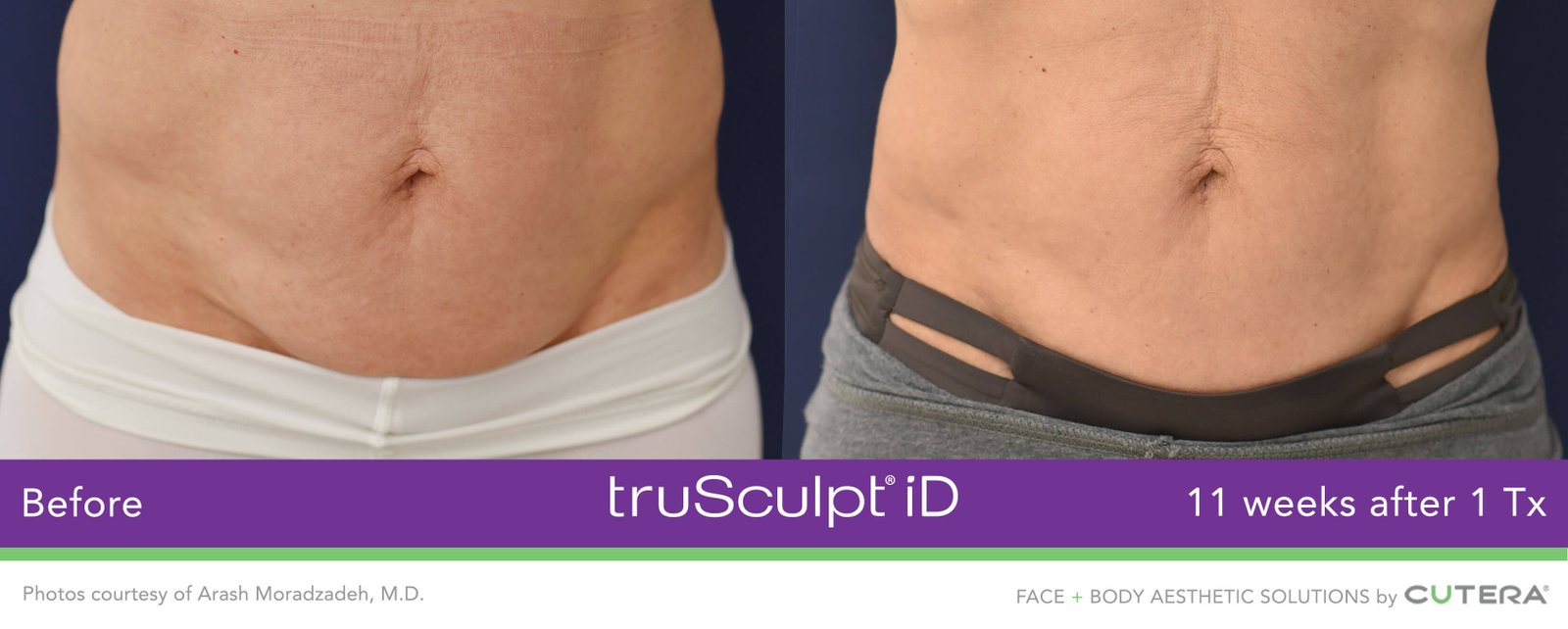
If you are considering truSculpt, before-and-after results can help you understand the type of body-contouring changes the treatment may produce. However, photographs should be interpreted carefully because individual outcomes vary.
truSculpt is a non-invasive radiofrequency body-contouring treatment. It is designed for localized fat reduction and body contouring rather than overall weight loss.
At TruSculpt Miami, Dr. Nina Gupta evaluates each patient’s anatomy, medical history, treatment goals, and expectations before recommending treatment.
Understanding what truSculpt can—and cannot—accomplish is an important part of deciding whether treatment is appropriate for you.
How Does truSculpt Work? Clinical Evidence & The "24%" Metric
truSculpt uses 2 MHz monopolar radiofrequency (RF) energy to deliver controlled, uniform volumetric heating to subcutaneous adipose tissue while keeping surface skin comfortable via contact cooling.
Cutera’s U.S. FDA clearance encompasses non-invasive lipolysis of the abdomen and flanks, as well as temporary reduction in abdominal circumference.
Understanding the 24% Clinical Data: Fat Thickness vs. Cell Count
In published clinical evaluations (Taub et al., Journal of Drugs in Dermatology, 2020), clinical researchers documented an average 24% reduction in subcutaneous adipose layer thickness measured via standardized ultrasound imaging at the 12-week study endpoint.
It is critical to interpret this clinical finding accurately:
- Not a universal guarantee: 24% represents a cohort average. In clinical trials, individual patient outcomes varied across a broad range (typically 15% to 28%+), influenced by baseline tissue thickness, metabolic rate, vascularity, and individual immune clearance.
- Layer thickness, not total body fat: The measurement assesses the millimeter thickness of the treated subcutaneous fat layer, not an elimination of 24% of all body fat or 24% of the body's total adipocyte population.
- Adipocyte biology: Fat cells that undergo thermal apoptosis are gradually phagocytosed and eliminated by macrophages over 8 to 12 weeks. However, surviving adipocytes remain metabolically active and retain the biological capacity to expand (hypertrophy) if a patient enters a sustained caloric surplus.
Treating "Non-Pinchable" vs. Pinchable Fat
A common challenge in aesthetic body contouring is that patients frequently present with different types of subcutaneous adipose deposits:
Pinchable Adipose
Pliable, soft fat tissue that can be pinched between fingers. While vacuum suction-based modalities (like cryolipolysis) require pinchable rolls of fat to draw tissue into a cooling cup, truSculpt treats these areas effectively without suction stress.
Non-Pinchable & Fibrous Fat
Flatter, dense, or fibrous subcutaneous fat layers that cannot be grasped or suctioned into a vacuum cup. Because truSculpt utilizes flat hands-free and handheld applicators, radiofrequency current flows based on electrical impedance rather than suction, allowing uniform thermal penetration into firm or non-pinchable fat deposits.
Skin Tightening: Evidence, Mechanisms, and Regulatory Realities
Prospective patients often ask whether before-and-after photos show skin tightening in addition to fat reduction. Clinically, it is essential to distinguish between primary FDA clearances and secondary thermal responses:
- Primary Indication: truSculpt is FDA-cleared specifically for non-invasive lipolysis (fat destruction) and reduction of abdominal circumference.
- Secondary Thermal Remodeling: As 2 MHz monopolar RF bulk-heats subcutaneous adipose tissue to therapeutic temperatures (43°C–45°C), the overlying deep dermis reaches approximately 40°C–41°C. This sustained therapeutic warmth can stimulate temporary collagen denaturation and trigger fibroblast-mediated neocollagenesis (new collagen synthesis) over several months.
- Clinical Limitations: This thermal reaction may result in modest skin smoothing or mild tissue contraction in patients with good baseline skin recoil. However, it cannot replace surgical skin excision (such as an abdominoplasty or panniculectomy) for severe skin laxity, heavy overhang, or post-bariatric redundant folds.
When Will I See truSculpt Results?
Results from truSculpt develop gradually rather than immediately.
First Few Weeks
Temporary redness, warmth, tenderness, or other treatment-related effects may occur. Visible contour changes may not yet be apparent.
Following Weeks
Changes in the treated area may become more noticeable gradually. The timing and degree of improvement vary among patients.
Around 8–12 Weeks and Beyond
Patients are commonly evaluated over the weeks following treatment to assess their response and determine whether additional treatment should be considered.
Before-and-after photographs taken under consistent conditions can be useful for evaluating changes over time.
Individual results and treatment requirements vary.
How Should You Evaluate truSculpt Before-and-After Photos?
Before-and-after photographs can be helpful, but they should be viewed in context.
For a meaningful comparison, photographs should ideally use similar:
- Lighting
- Camera position
- Distance
- Patient positioning
- Clothing
- Posture
- Timing after treatment
Photos should represent actual patient outcomes and should not be interpreted as a guarantee that another patient will achieve the same result.
Changes in weight, exercise, nutrition, medications, or other treatments between photographs can also affect appearance.
During your consultation, ask what degree of improvement is realistic for your individual anatomy and goals.
Comparing Non-Surgical Body Contouring Modalities
Radiofrequency vs. Cryolipolysis
While cryolipolysis freezes fat using suction applicators, truSculpt delivers controlled radiofrequency heating across customized flat handpieces. Different non-invasive modalities have different indications, comfort profiles, and suitability depending on tissue composition.
Non-Surgical vs. Liposuction
Liposuction is a surgical procedure for larger-volume fat removal requiring anesthesia, incisions, and surgical recovery. truSculpt is a non-invasive option designed for moderate, localized contouring without surgery or extensive recovery.
Supporting Your Body-Contouring Goals
Maintaining a stable weight and following generally healthy nutrition and physical-activity habits can help support long-term body-contouring goals. Follow the specific post-treatment instructions provided by your treating clinician.
Cutera describes truSculpt as providing long-lasting fat reduction. Individual results vary, and subsequent weight changes, aging, lifestyle factors, and other changes in body composition can affect appearance over time.
What Should You Realistically Expect?
truSculpt can be considered for appropriately selected patients seeking non-surgical body contouring rather than significant weight loss.
Results vary from person to person. Before-and-after photographs can provide useful examples of individual patient experiences, but they cannot predict your own outcome.
The most important question is not whether another patient’s before-and-after photograph looks impressive. It is whether truSculpt is appropriate for your anatomy, goals, medical history, and expectations.
If you are considering truSculpt in Miami, schedule a consultation with Dr. Nina Gupta to discuss whether treatment is appropriate for you and what degree of improvement may reasonably be expected.
Individual results vary. This information is educational and does not replace an individualized medical evaluation.
— Dr. Nina Gupta, MD